CHAPTER 22 OF 29
Entelect: the whole architecture
Two domains of intelligence, three scales of application, and shared oversight.
Entelect is the proposed intelligence infrastructure that connects better knowledge with the development of persons and the improvement of their shared institutions.
- 01Social Intelligence investigates the conditions and arrangements shaping human outcomes.
- 02Human Development Intelligence supports assessment, learning, mentorship, and meaningful opportunity.
- 03Shared Meta Intelligence and Oversight examines the reliability, objectives, and consequences of both domains.
In this chapter · 8 sections
Social Intelligence
Outcomes · Evidence · Causes · Institutional improvement
DOMAIN 02Human Development Intelligence
Assessment · Development · Education · Mentorship · Opportunity
Meta Intelligence & Oversight
Evaluate the models, examine the objectives, correct the errors, and preserve accountable authority.
Scales of application: person · organization · society
A system of capabilities, not one omniscient model
Entelect names a coordinated architecture of tools, evidence practices, and accountable institutions. It could include language models, databases, statistical methods, specialist software, human expertise, and interfaces for inquiry and decision. A particular chatbot, tutor, assessment, or policy service would be a component or limited application of that larger architecture.
The proposal responds to a coordination problem. Researchers know something about average effects; professionals understand implementation; individuals know aspects of their circumstances and aims; institutions hold records of decisions and outcomes. Entelect seeks to make these forms of understanding mutually informative while preserving their different evidential status.
Two principal domains
Social Intelligence examines the conditions under which lives unfold. Its Eudometric Engine describes outcomes; its Evidence and Epistemic Engine appraises knowledge; its Causal Intelligence Engine investigates interventions; its Aretonomic Engine compares feasible courses of institutional action.
Human Development Intelligence addresses persons and their possibilities. Its Psychometric Engine integrates relevant assessments; its Developmental Engine explores capacities and pathways; its Eudodidactic Engine supports education; its Mentorship Engine assists deliberation and practice; its Opportunity and Role Fit Engine connects people with meaningful possibilities.
An engine is a defined function with identifiable inputs, outputs, and limits. It need not be a separate AI model or department. The functional distinctions should survive changes in technology so that an assessment does not quietly acquire the authority of a decision and a recommendation does not become a compulsory assignment.
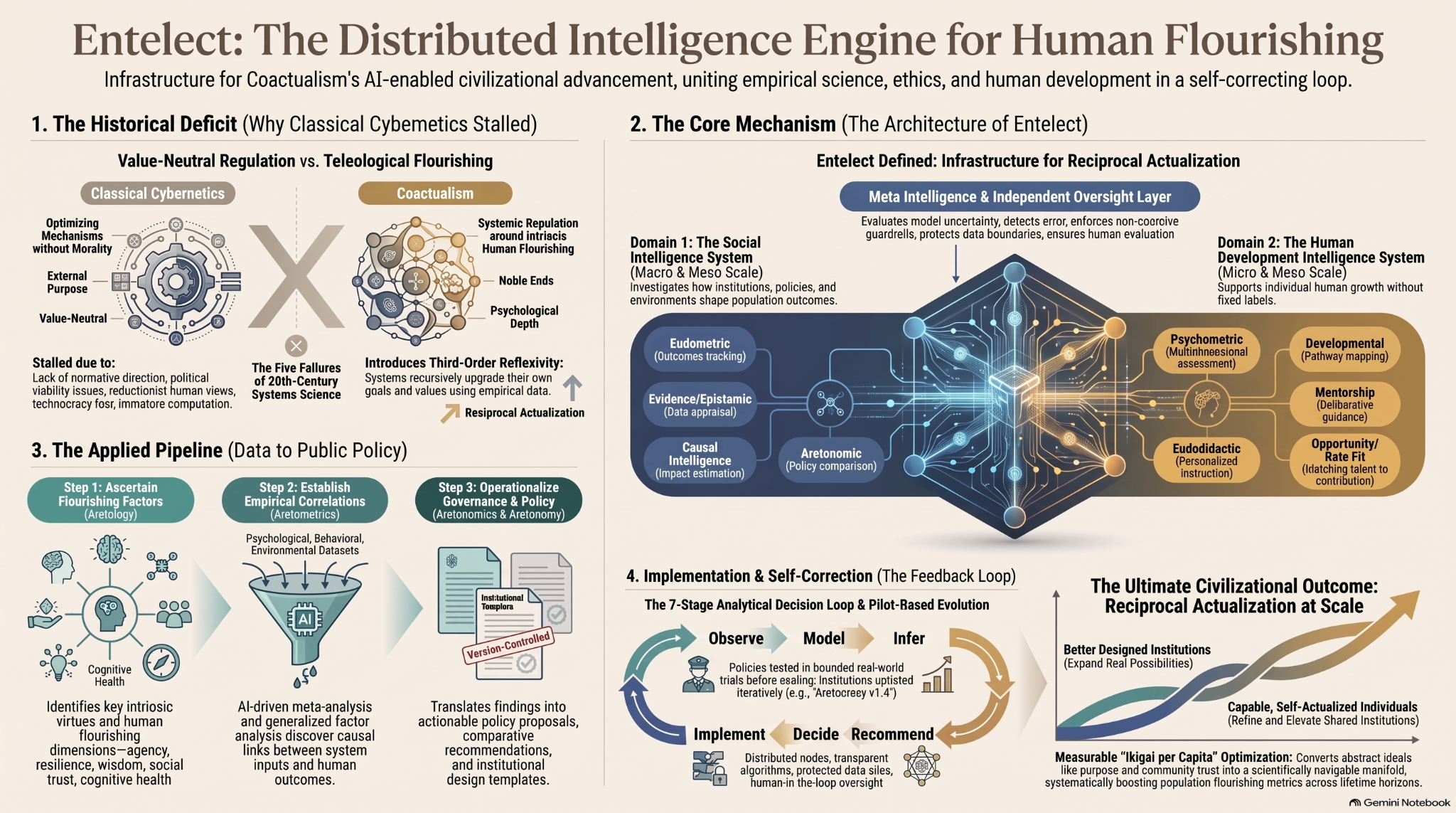
Entelect would connect research on policies and institutions with tools for learning, mentoring, and finding opportunities. People would oversee both sides, test recommendations in practice, and use the results to improve the system.
View full-size infographic (opens in a new tab)Three scales, independent of function
Micro Entelect concerns persons and immediate circumstances. Meso Entelect concerns schools, teams, organizations, families, and communities. Macro Entelect concerns populations, public systems, economies, and wider institutions. These scales cut across both principal domains rather than forming three isolated systems.
The meso level is especially consequential. A national educational commitment becomes real through a school; a person's opportunity to contribute depends on the organization around them. If many capable people struggle under the same procedure, the institution may need redesign. Personal guidance should not become a way to train people to endure avoidable systemic dysfunction.
Authority is a third dimension
Function describes what a tool does. Scale describes where it operates. Authority describes what its use may legitimately decide. A voluntary reading recommendation and a decision about educational access can use similar analytical capabilities while requiring very different justification and review.
The person or institution authorized to decide must remain identifiable. Evidence can inform a choice without conferring political legitimacy on the model that assembled it. Competent human responsibility remains necessary, and epistemic discipline determines the strength of the conclusions being offered.
Meta Intelligence and Oversight
The shared layer evaluates models, evidence practices, incentives, uncertainty, errors, and downstream effects. Technical self-monitoring can identify drift or inconsistency, but cannot conclusively certify its own reliability. Independent reviewers and affected people need meaningful ways to challenge consequential uses.
Oversight must have practical capacity: relevant information, time, expertise, and authority to stop or change a decision. A human signature on an unread recommendation provides little protection. Scrutiny also extends to objectives. Entelect should permit the question “Are we optimizing the wrong thing?” rather than treating resistance as a failure of the person.
Building toward the architecture
Entelect remains a proposed system whose components need separate construction and evaluation. A useful research service does not demonstrate readiness for high-stakes placement. A successful tutor does not prove comprehensive social prediction. Integration introduces new interactions that require their own assessment.
The criterion is practical improvement over credible alternatives: better judgment, stronger agency, wider developmental opportunity, and institutional changes whose benefits survive scrutiny. Increasing dependence on Entelect is not itself evidence of success. The website's conversational guide explains the philosophy; it is not the completed intelligence system described here.
AN ILLUSTRATIVE APPLICATION
A school learns at three levels
A learner receives adapted instruction and mentorship. The school examines whether its schedules and assessments obstruct similar learners. Wider research compares the intervention with alternatives. Findings move between the levels with their context and limits. Private guidance records remain bounded, while appropriate evaluation can improve both the school and the general account of what works.
CONTINUE ALONG THE THREAD
Follow the connections
Social Intelligence
The four engines serving research and institutional improvement.
Human Development Intelligence
The five engines serving personal development.
Alethia
The epistemic discipline that gives both domains accountable foundations.
FROM READING TO CONVERSATION
What would you like to explore?
Take an idea from this chapter further. Choose a starting question, then make it your own before sending.
What should a system know, what should it recommend, and what should it be authorized to decide?
Explore this questionAsk your own question